

Clinical leaders
Identify where AI can relieve cognitive load while preserving clinician judgment and accountability.
 AI in Healthcare
Identify where AI can relieve cognitive load while preserving clinician judgment and accountability.

Design tools around real care workflows and the people who use them every day.

Set meaningful baselines, validate clinical value, and monitor systems after launch.
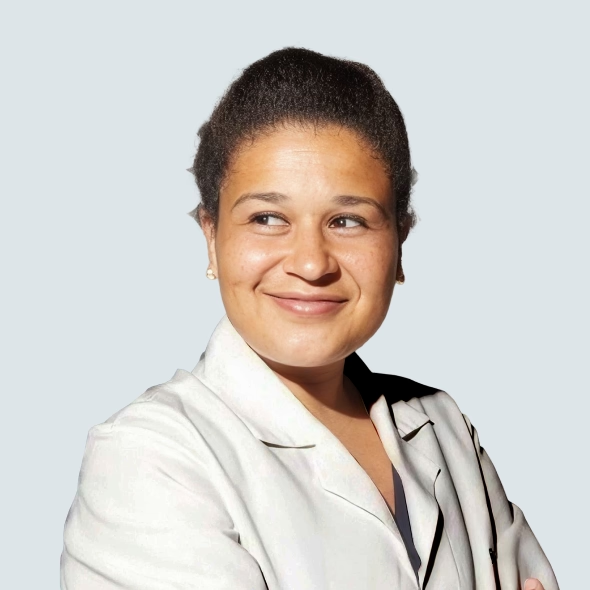


Kimberly Noel is Global Lead, AI Advocacy & Digital Health at Roche. A physician with experience in clinical medicine, digital health, and AI, she previously served as Deputy Chief Medical Information Officer at Stony Brook Medicine and founded Human in the Loop. She is also an editor at npj Digital Medicine.

Hosted by Sergiy Sumnikov
General Manager, Health Innovation at Halo Lab
Map the clinical workflow and identify the task that creates friction before choosing a model or feature. Agree on a baseline so the team can tell whether the intervention truly reduces work.
Separate routine, lower-risk tasks from decisions that need expert review. Put human checkpoints at consequential or irreversible decisions without adding alerts to every step.
Bring clinicians into design and testing as partners. Include patient, legal, and ethics perspectives, and make it clear who owns the decision when AI contributes to care.
Compare documentation time, cognitive load, and burnout alongside patient experience and clinical outcomes. Monitor both intended benefits and new work the system may create.
Keep it easy to question or override a recommendation. Train teams on failure modes, watch for over-reliance, and continue clinical validation and surveillance in production.




Become a part of our growing community of innovators.